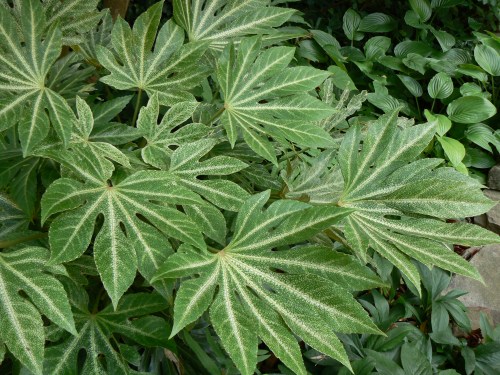
Fatsia japonica ‘Spider’s Web’
© All photos & text 2010
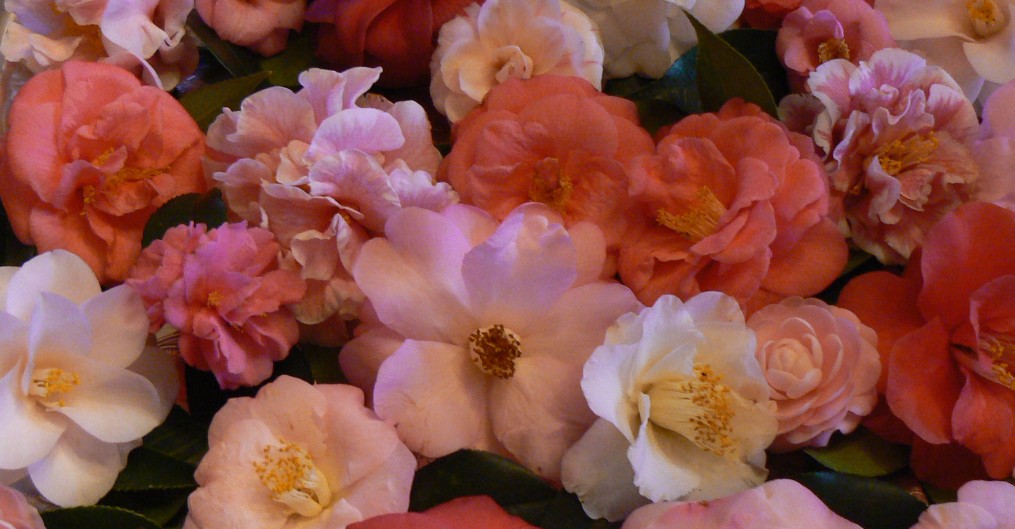
Fatsia japonica ‘Spider’s Web’
© All photos & text 2010

If they combine well in the garden they will combine well in the vase.
The hydrangeas are at their peak. This year they are particularly beautiful having benefitted from a long cold winter.

 Hydrangea macrophylla (unknown) on left & Hydrangea macrophylla ‘ Lilacina’ above
 Hydrangea quercifolia ‘Snowflake’ is non-stop hose in hose flowers.


Hydrangea arborescens ‘Annabelle’ on left and Hydrangea macrophylla ‘White Wave’ (above)

Hydrangea arborescens ‘Hayes Starburst’ a variation of the native found by Hayes Jackson.
As a result of last weeks garden tour, I have added a pot to the Circle of Friends.


Much better. Someplace for the eye to rest.
PORTRAITS:

Above Hydrangea macrophylla ‘Jogasaki’ Below, Hydrangea serrata ‘ Beni Gaku’


The stunning Hydrangea macrophylla ‘Geoffrey Chaudbund’

And the mysterious “From Penny’s back door” If anyone can ID this I would appreciate it.
© All photos and text 2010
That Brilliant idea in my last post was that of Robert Meaders’, architect extraordinaire. Also seen in his garden…

A welcoming collection of pots,

an urn, perfectly placed in a border.

Another pot, that echoes the foliage of the hostas and the hydrangeas beyond.

Many other delightful & unique features make this garden truly special.
Thank you Robert.
©All photos and text 2010
Seen on the garden tour last weekend.

Between two windows, a blank brick wall is made into a sensational seating area.

Not only does it overlook the garden, it reflects it!! Yes, that is a mirror. Brilliant!
© All photos & text 2010
Yesterday I ventured into Atlanta for one of the annual garden tours.
This year the majority of gardens were small urban spaces, well-appointed for outdoor living.

Above, a comfortable chaise in shade for reading and listening to the sound of the waterfall (below).


Festoons of ivy grace an otherwise nondescript wall along a driveway.

Lushly planted window boxes.

And below, a private putting green!

I will share more highlights during the week.
I tried to grow some Clematis with Hydrangea paniculata, the late-blooming panicle hydrangea, (sometimes refered to as ‘Pee Gee’ or ‘Tardiva’.) but this is not successful.

Clematis Purpurea Plena Elegans In Hydrangea paniculata ‘Pink Diamond’ ( above & below) 
This hydrangea is pruned drastically early spring. When the clematis starts to grow, the branches of the hydrangea are low and bare . There, they intertwine. The hydrangea however, keeps on growing, thus the clematis blooms deep in the shrub and not in front, where it is wanted.
Here Clematis texensis ‘Gravetye Beauty’ hidden in foliage. 
Another lesson learned.
‘
The very first bloom on ‘Mini-Penny’. (Hydrangea macrophylla ‘Mini-Penny’)

Oakleaf hydrangeas line a path below

leading to more heavenly hydrangeas.

Above, a glorious mix of Hydrangeas. Oakleaf (Hydrangea quercifolia) Annabelle (Hydrangea arborescens ‘Annabelle’) and blue mopheads,(Hydrangea macrophylla) assorted, many of them Penny Macs.

Variegated kerria (Kerria Japonica ‘Pictum’) weaves it way through Hydrangea “Annabelle’ (Hydrangea arborescens ‘Annabelle’) Gold Heart Ivy (Hedera helix “Gold Heart’) climbing the trees.

The ‘Circle of Friends’ consists of camellias and hydrangeas, either gifted to me, or those that arrived via cuttings from friend’s gardens. The identity of some have been lost, they therefore wear ID tags that read ‘From Penny’s back door’ or ‘Lacecap at Penny’s stream’, indicating where they originated.
The inverted pot served as a plinth for St. Fiacre, but he is temporarily needed elsewhere. (I have a shortage of statuary.)

Above,’ Penny Mac’ (Hydrangea macrophylla ‘Penny Mac’) Blue, and ‘Madame Emile’ (Hydrangea macrophylla ‘Madame Emile Mouillere’) White.
This show is just starting. I rely on the hydrangeas to carry the ornamental garden through the summer months. As the blossoms age they become papery. They can then be harvested for winter arrangements.
© All photos & text
And yet another southern beauty…
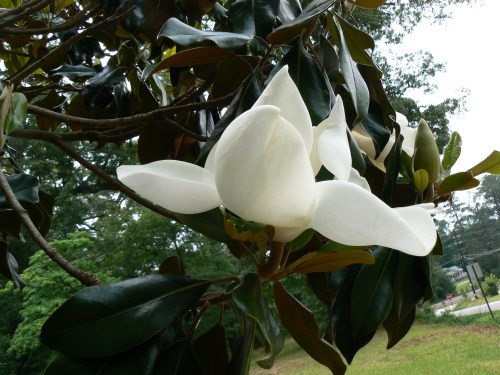
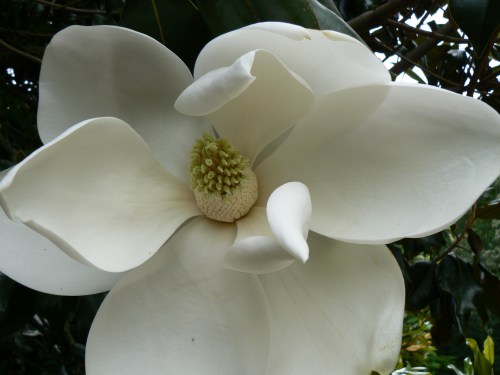
Southern Magnolia (Magnolia grandiflora)
The fragrance is indescribable! It does, however, conjure images of iced sweet tea , enjoyed on the veranda.
© All photos and text 2010
Just in case I needed another reason to love gardening in the south…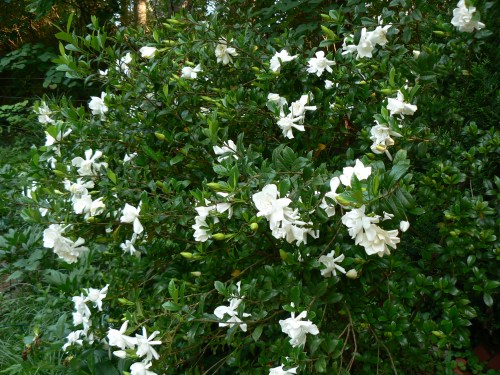
The gardenias are blooming. Wish I could post the fragrance!
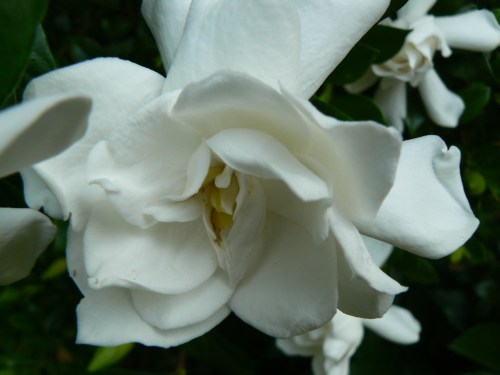
Are you getting it?
© All photos & text 2010
I am in a quandary.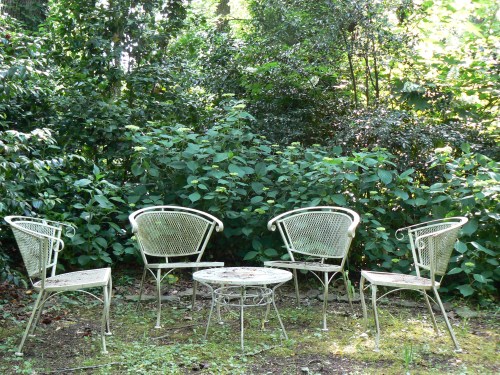
Do I paint these black (matt) or pale blue?
Surrounded by hydrangeas the blue would be whimsical, but what about when the camellias show in pink red & white?
Recently, Tara Dillard of A Garden View, posted about frames in the landscape. It brought to mind a lovely vignette I saw in a garden while in England. Initially I thought an artist had set up to paint.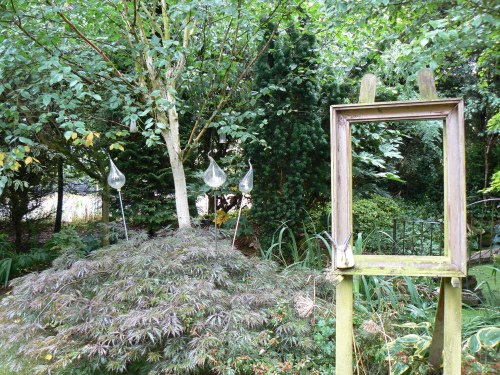
As I approached
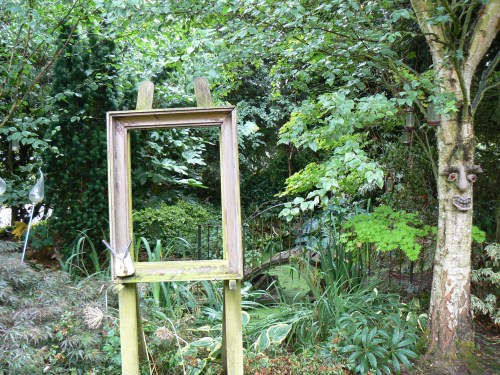
I saw
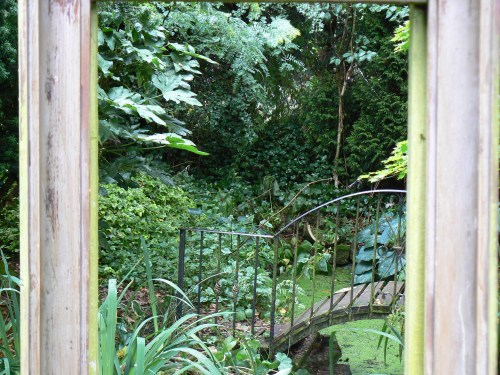
What had been ‘Framed’.
The lesson here is that framing a view brings it into relief. Scroll back to the last photo, see the difference? See Tara’s post here.
©All photos & text 2010
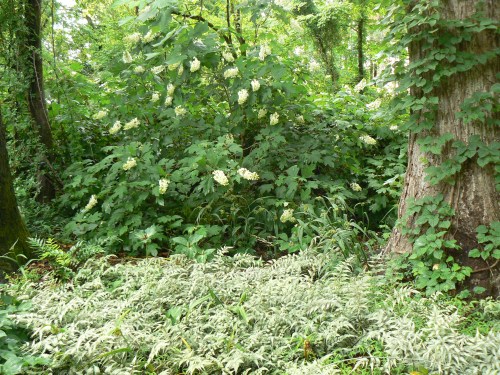
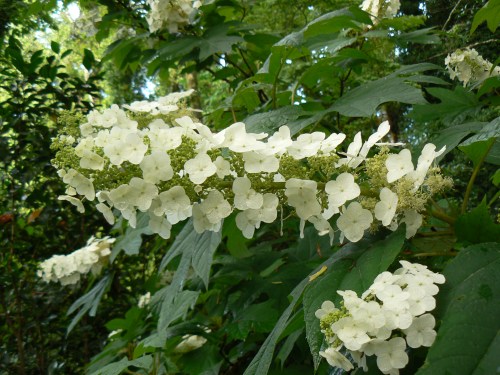
Plants with a cascading habit, call attention to the ground plane. Above, The heavy flowers of Snowflake Hydrangea (Hydrangea quercifolia ‘Snowflake’), draw the eye to the Japanese painted fern (Athyrium nipponicum).
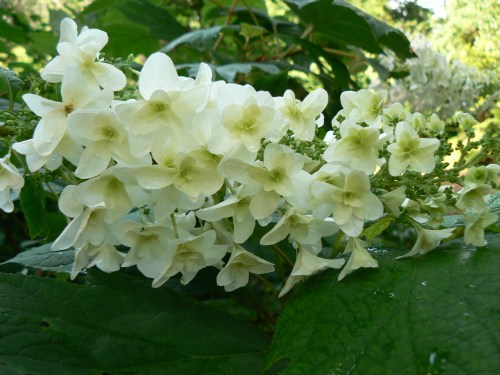
The flower on ‘Snowflake’ has double sepals, significantly different from that 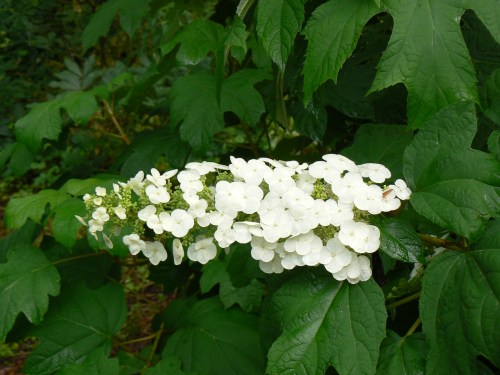 of ‘Amethyst’ above, or ‘Alice’ below.
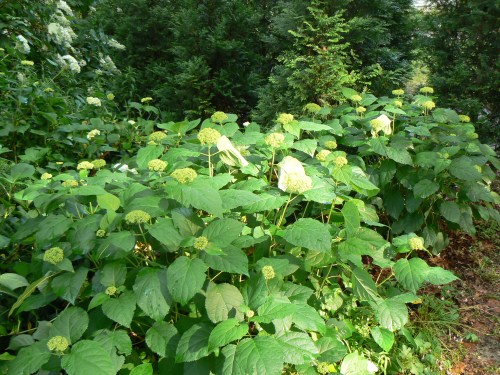
Hydrangea arborescens ‘Annabelle’ forming it’s flower heads. This is one hydrangea that SHOULD BE PRUNED early spring. These hydrangeas form flower buds on NEW GROWTH.
UPDATE ON EPHEMERALS:
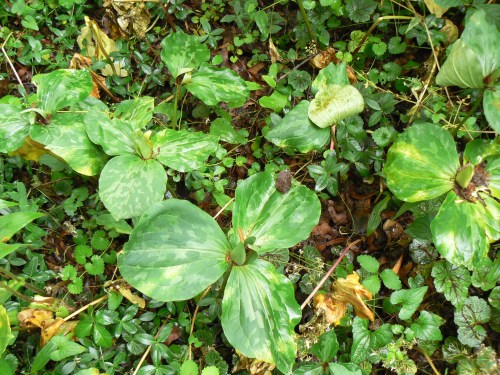
The Trillium are fading, (see yellow foliage). What will clothe the ground now is Vinca. I really tried for Selaginella kraussiana aurea, below
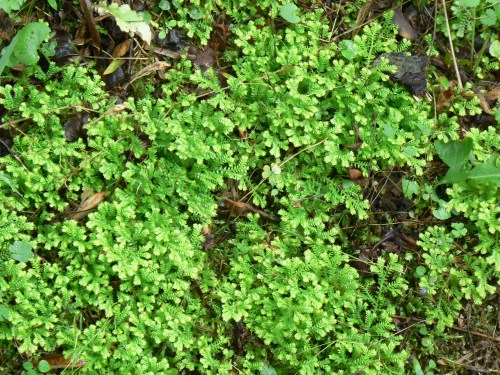
but it prefers the path so I’m going to stop fighting and let the vinca do its thing.
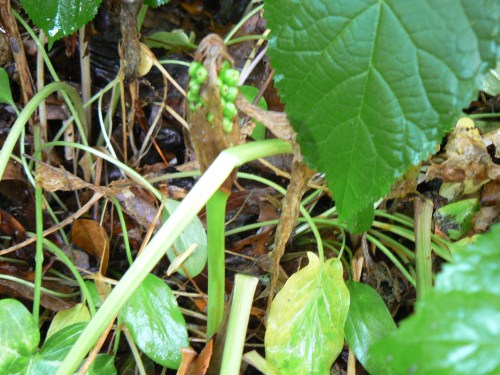
Arum foliage has died down & the berries have formed. They need to ripen, then they will be spread where more are needed. See previous post on Arum.
FINALLY THE POTAGER:
Below squash, peppers, cucumbers, beans, Eggplant 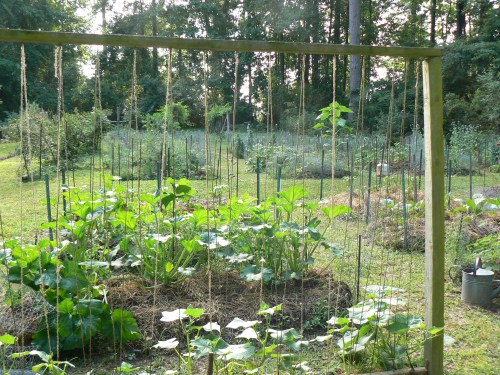
and below, TOMATOES!! 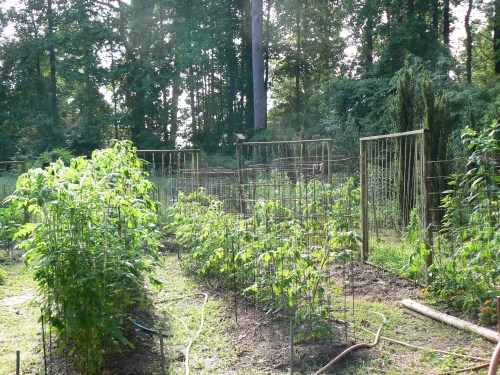
Have a great week end!
©All photos and text 2010
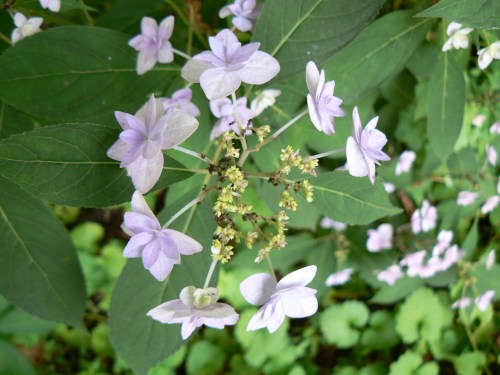
The Hydrangea serrata are in bloom.
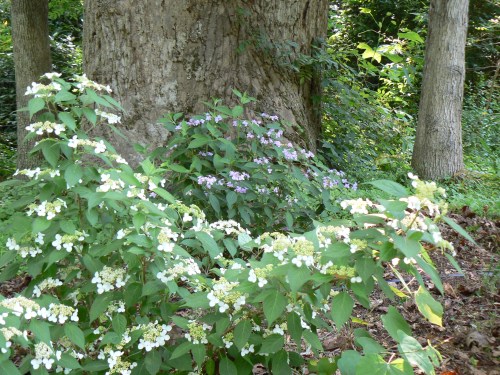
Hydrangea serrata ‘Kurenai’ + Hydrangea serrata ‘Shichidanka’
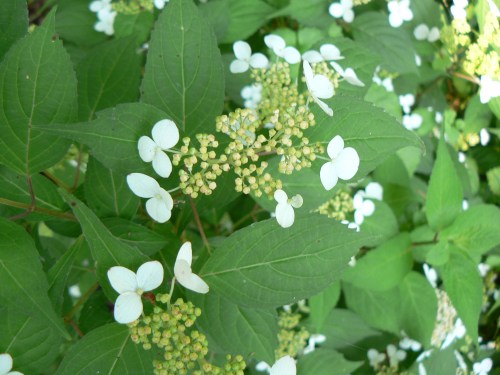
Close up of flowers, H. serrata ‘Kurenai’ above. H. serrata ‘Shichidanka’ below.
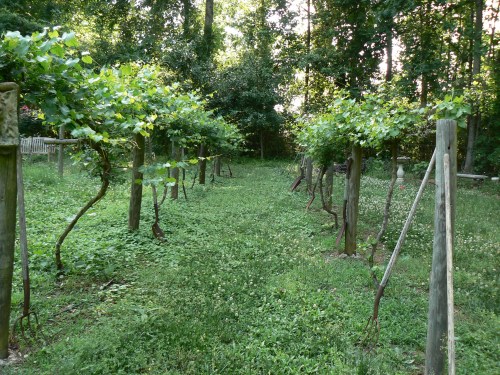
The grapes will soon obscure my old tool collection. below.
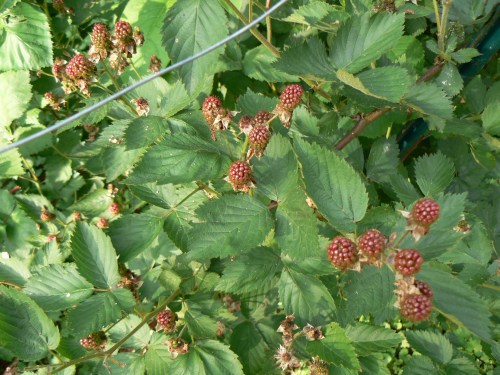
Mouth watering anticipation…Blackberries (thornless).
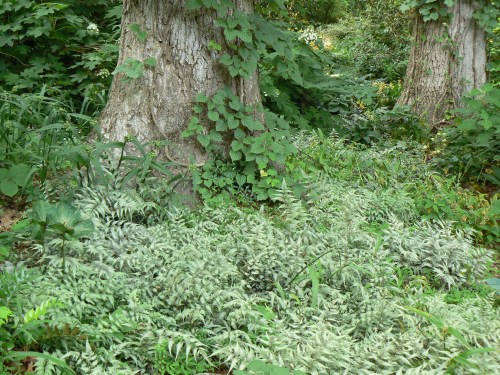
Base of Tulip poplar (Liriodendron tulipifera) with a river of Japanese Painted fern (Athyrium nipponicum) & Japanese Hydrangea-vine (Schizophragma hydrangeaoides ‘Moonlight’) Below.
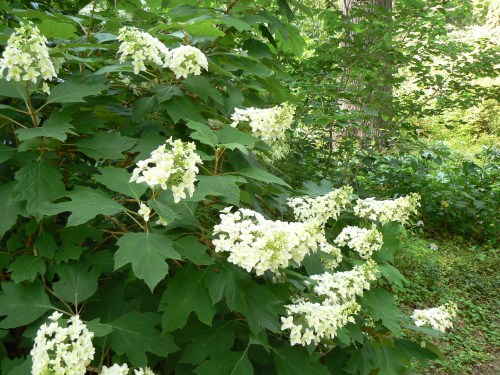
Oak Leaf Hydrangeas ( Hydrangea quercifolia) below, in all their glory.
© All photos & text 2010
I previously mentioned my Clematis Crush ( here and here ). Beside the beautiful flowers, the fact is they require only vertical space. That makes them the perfect companion to any shrub or small tree. Most shrubs have a limited bloom time so a well-chosen flowering vine can really extend the season of beauty. Also, from a design point of view, any element seen at eye level has tremendous impact.
I thought I would showcase some of the clematis blooming in the garden now.
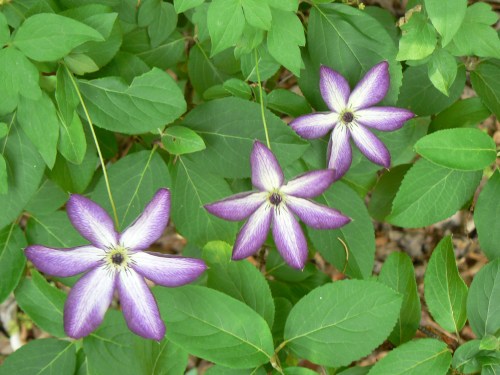
Clematis viticella ‘Venosa Violacea’ climbing through a viburnum.
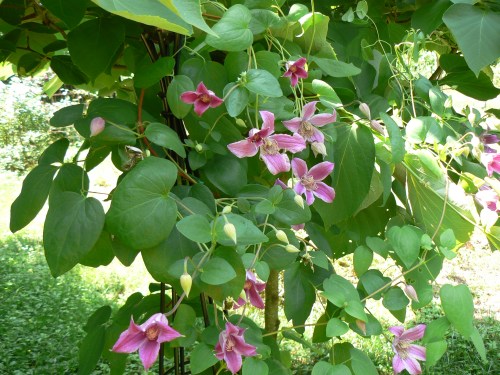
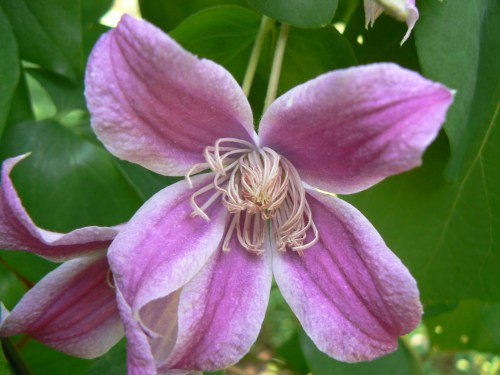
Clematis texensis ‘Catherine Clanwilliam’ on an obilisk till it reaches into the branches of Styrax obassia. Below, looking up into the flowers.
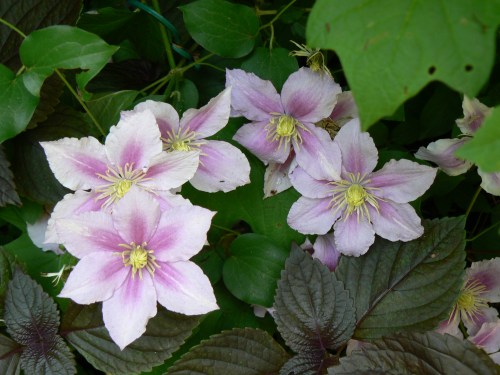
Clematis ‘Piilu’ or sometimes called ‘Little Duckling’, an Estonian hybrid with smaller flowers.
Most of the above are blooming in viburnums that are passed their peak. The clematis fill the gap between bloom time and berries in this part of the garden.
Below, Clematis ‘Rouge Cardinal’ being trained to clothe Hydrangea quercifolia ‘Snowflake’.
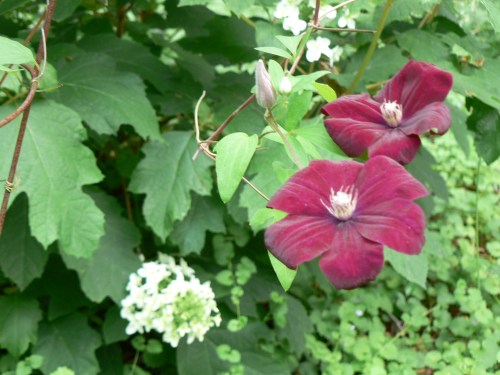
Finally, Clematis purpurea plena elegans, chosen to bloom with the roses. Below.
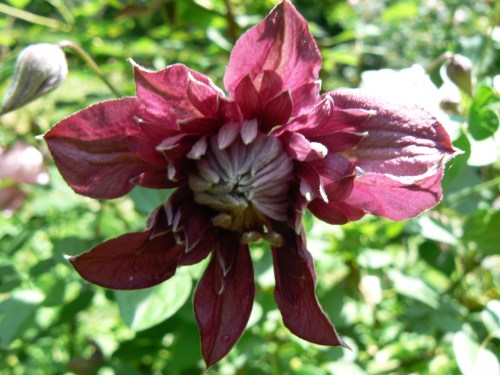
I hope you consider adding some to your garden.
© All photos & text 2010
 Recreating Eden Landscape Blog